Ultimate Toyota Pickup Off-Road Build with 35”s & Lockers

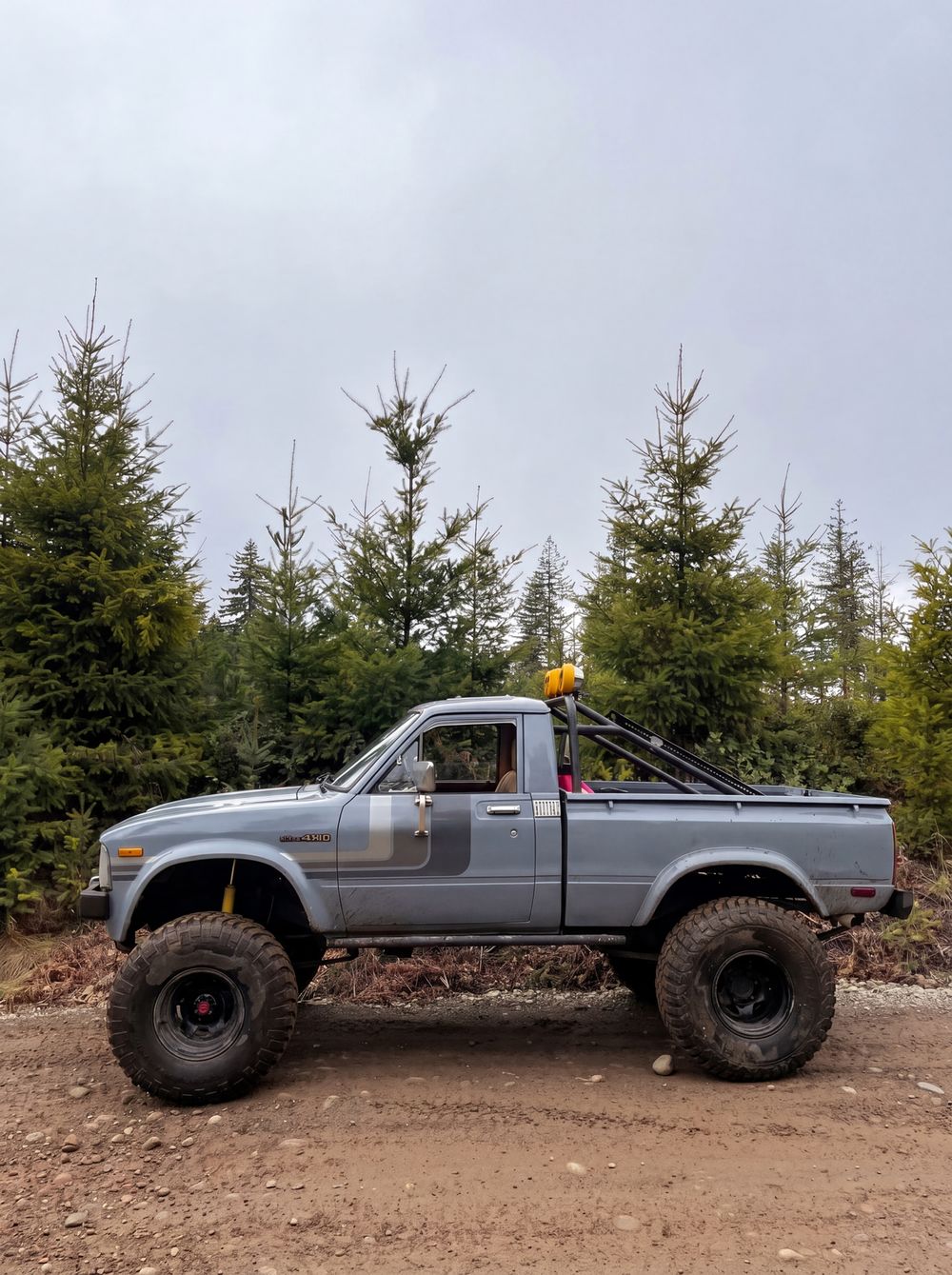
There is a fine line between a dedicated rock crawler and a nostalgic trail rig, but every once in a while, we stumble upon a build that completely blurs the boundaries between these two styles.
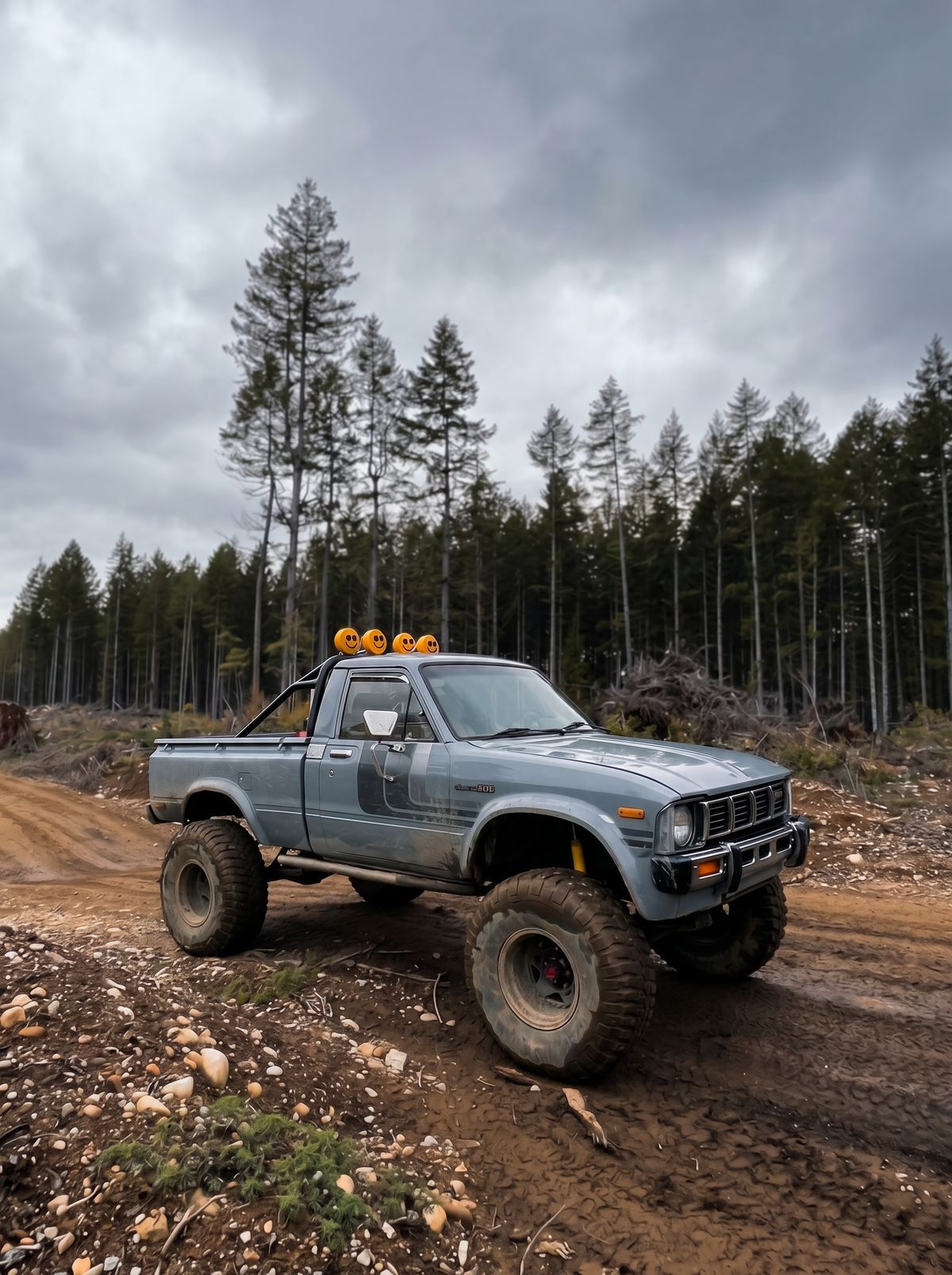
The 1981 Toyota Pickup (or Hilux, as it’s affectionately known outside the US market) we’re featuring today is exactly like that. This build perfectly combines that clean old school “mini-monster truck” appearance with some highly technical modifications in the performance, drivetrain and suspension departments, making it the ultimate example of an advanced off-road rig that can challenge modern 4x4s. Let’s dive deep into the mechanical alchemy behind this Toyota Pickup off-road build that makes it so capable.
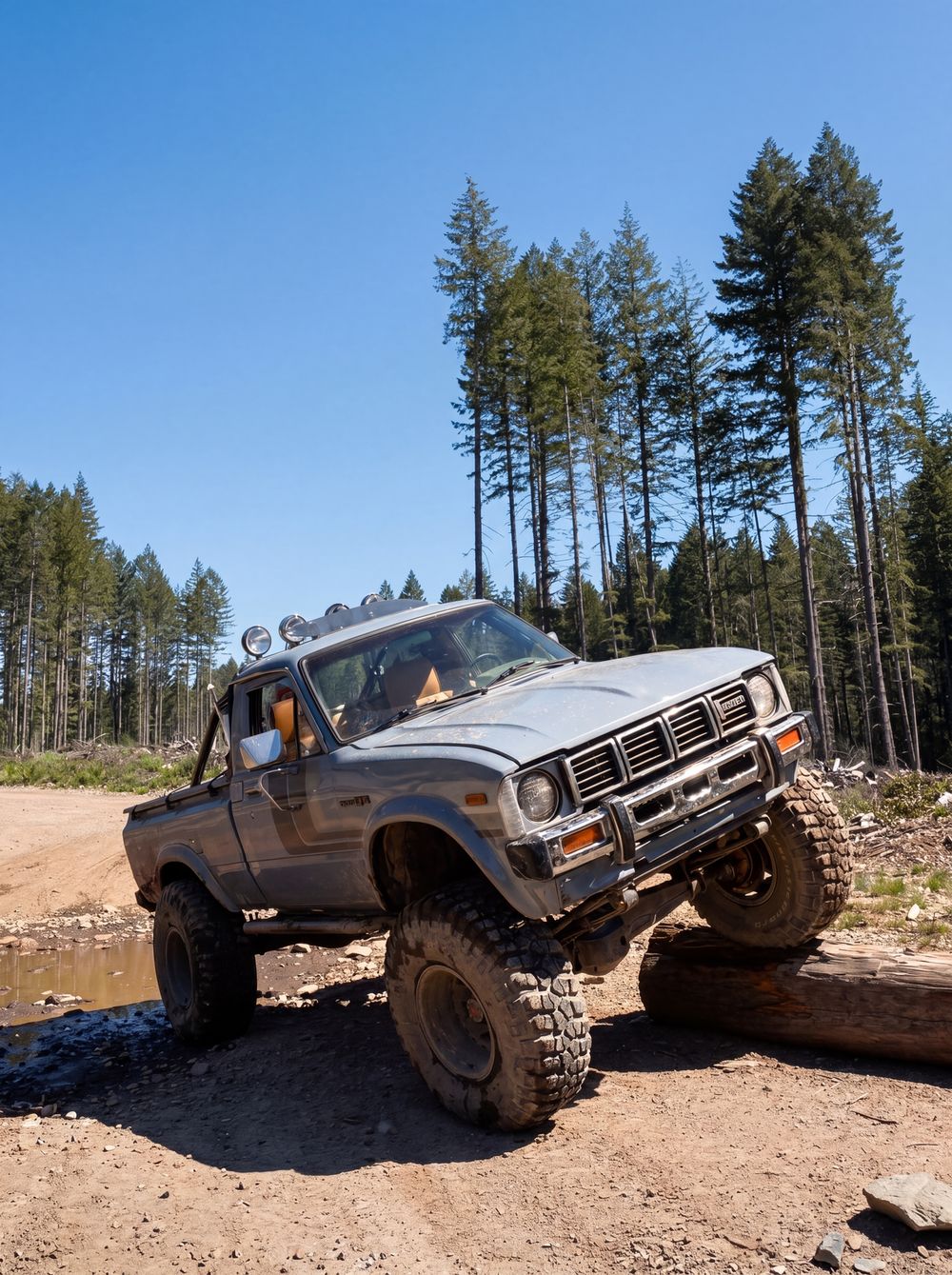
Key Specs
| Category | Upgrade Components |
|---|---|
| Engine | 3.4L 5VZ-FE V6 with stock-pulley TRD supercharger |
| Cooling & Fuel | Generic 3-row aluminum radiator, electric fan, Walbro 255 lph fuel pump |
| Drivetrain | R150 transmission with Advance Adapters adapter, Exedy clutch, Trail-Gear rear sump oil pan |
| Transfer Case | Trail-Gear 4.7-to-1 low-range gears, twin-stick shifters, transfer case-mounted e-brake |
| Front Suspension | RUF (Rear Springs Up Front) 2nd-gen leaves, Fox 2.0 reservoir shocks |
| Rear Suspension | Trail-Gear 5″ lift springs, Bilstein 5100 shocks |
| Steering | Trail-Gear high-steer kit with IFS steering box |
| Axles & Diff (Front) | IFS hubs, ARP studs, 5.29 Yukon gears, ARB Air Locker, Longfield chromoly shafts |
| Axles & Diff (Rear) | 5.29 Yukon gears, Detroit Locker, Longfield chromoly shafts |
| Driveshafts | NW Driveline long-slip |
| Wheels & Tires | American Racing 15×10 wheels (4.5″ backspacing) on 35″ BFG KM3 mud-terrains |
The Build
The 1979-1983 Toyota Pickup at its core is the car-size body-on-frame compact truck with a live solid front axle. Toyota switched to an independent front suspension in 1986, so this is the last generation of the model equipped with solid front axle thats so much appreciated by off-road enthusiasts.
The solid axles provide very good articulation, and because there is no independent suspension, the ground clearance under the differential does not change when the suspension compresses. There are also no CV boots or torsion bars for rocks to damage.
Instead of common by today’s standards shocks and struts, this truck had leaf springs on all four corners and a gear-driven RF1A transfer case with a 2.28-to-1 low range.
Being an old truck designed in the fuel crysis era of the late 70s, it was equipped with a fuel efficient 2.4L 22R engine, which by the way had a cast-iron block, and a simple timing chain, which made it very reliable. Its modest performance of 97 horsepower was enough to spin narrow stock 28″ tires, but fitting the truck with bigger A/T or M/T rubber becomes a real challenge for it.
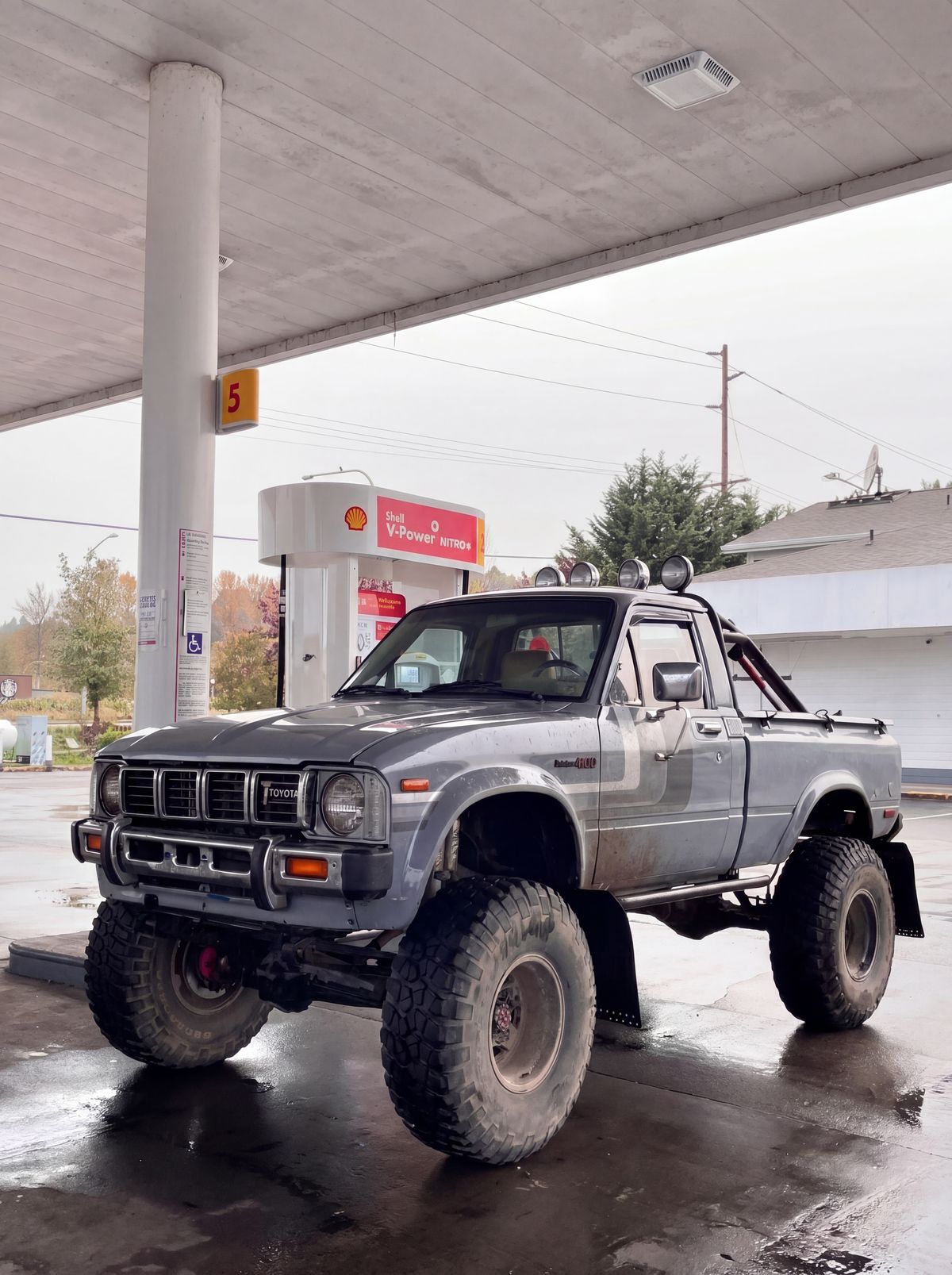
Zacq chose this platform for common reasons. “I chose the Hilux mainly because of the parts availability, and I’ve always loved the look of the 79-83,” he told me. “Also they are well made and can take so much abuse.” Deciding on the direction of the build took longer. As he put it, the hardest part was “trying to figure out if I wanted to do a crawler, show, trail-truck or a beater build.
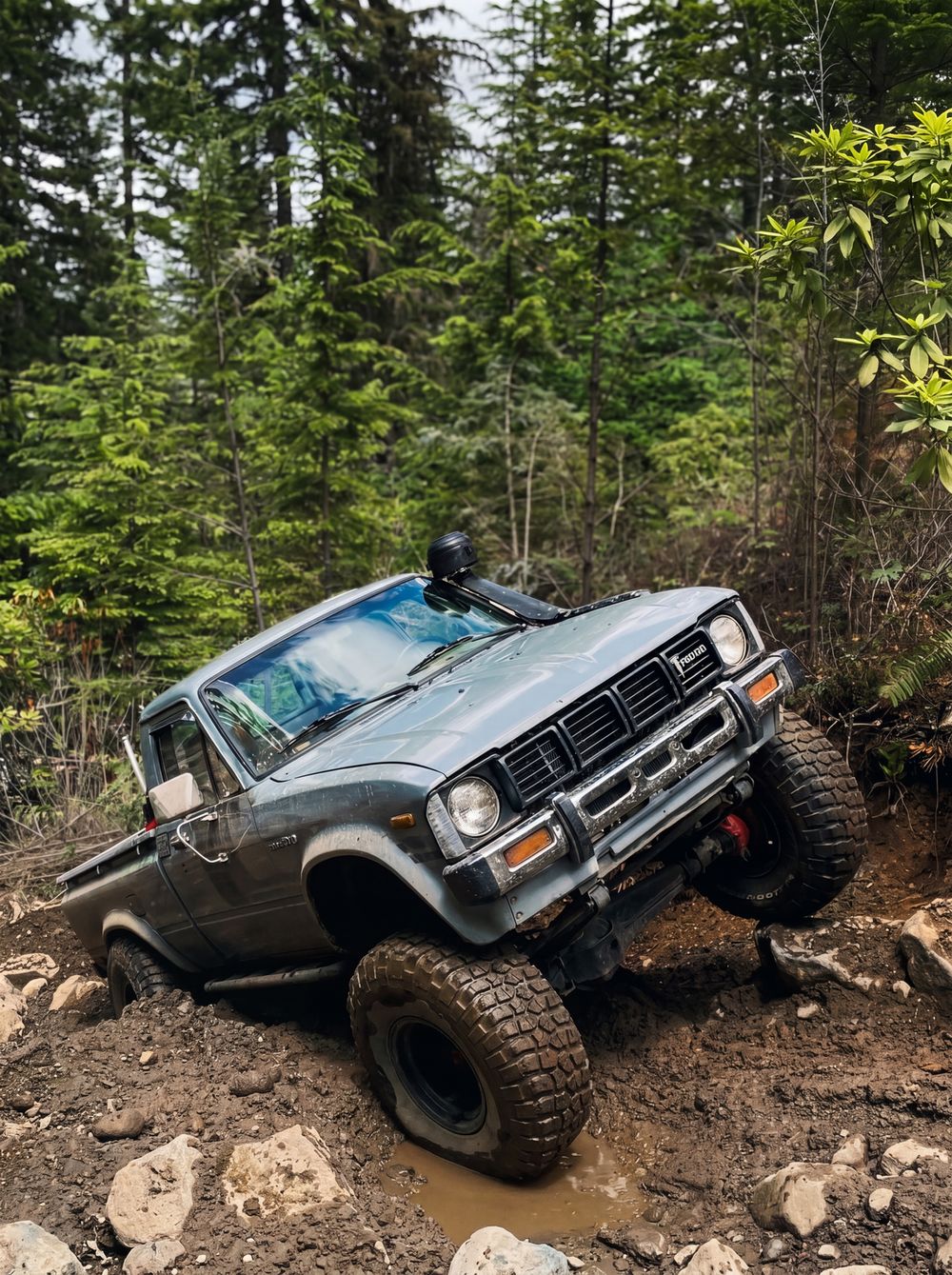
“I couldn’t make up my mind so it’s a mixture of all those.” That is why the finished build combines a wide stance with a genuinely trail-capable drivetrain. Thanks to this awesome combo it handles muddy, rutted trails of the Pacific Northwest and technical rock terrain equally well.
Wheels & Tires
The wheel choice fell on the set of extremely wide (for this platform) 15×10 American Racing rims with 4.5-inch backspacing, wrapped in 35×12.50R15 BFGoodrich KM3 tires.
A 10-inch-wide wheel like this helped Zacq to achieve that wide stance look he always wanted.
At 4.5 inches of backspacing, the mounting face sits well inboard on the wheel, which pushes it outward and away from the frame. This keeps the 12.5-inch-wide tire from contacting the leaf springs and steering linkage at full steering lock.
A 35-inch tire is obviously a little bit too extreme for this little rig, but capability-wise it makes the truck simply unstoppable. 35s provide significant differential clearance and a large footprint for any type of terrain. In addtion to that, with the 15″ rim diameter this tire has a side profile of about 10″, which is massive for airing down.
There are trade-offs to this setup, though. Each KM3 weighs roughly 65 lbs, and that added rotating mass increases wear on brakes, bearings, and gearing, so all of these components needed to be reinforced (more about this later). The wider track also reduces one of the main advantages of this platform – the narrow body which measures just 63″ wide and fits through tight, wooded trails other trucks just can’t slip through.
Budget Estimate
Estimated cost for the wheel and tire package is around $2,650 to $3,450 for five KM3 tires and five 15×10 wheels, including mounting and balancing. The tires cost roughly $320 to $365 each, and the American Racing wheels run $180 to $260 each, which keeps the overall cost reasonable for a premium tire paired with a mid-priced wheel.
Suspension & Steering
To fit 35 inch tires and make them work properly, the owner utilized RUF conversion (Rear Springs Up Front), which replaced short and stiff stock leaf springs with the longer rear leafs from a 1984-1988 second-generation Toyota trucks.
Thanks to this upgrade the front axle moved forward by roughly two inches, which improved the wheel base, approach angle and kept the tires from contacting the firewall when the suspension fully compresses. The longer springs also provide a significantly better articulation, which matters a lot for off-roading.
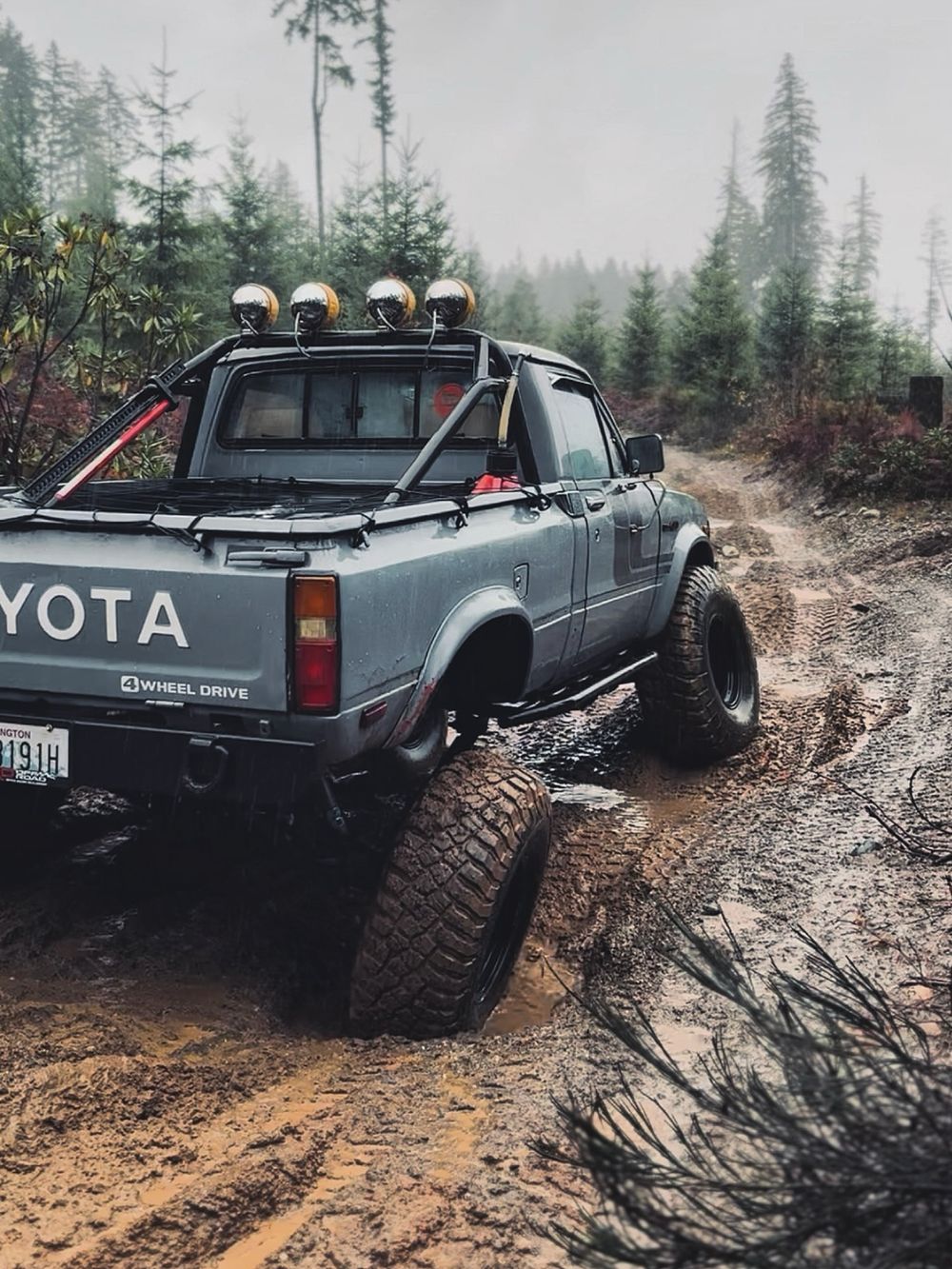
The front shocks are represented by Fox 2.0 units with remote reservoirs. Up on the back are Trail-Gear 5-inch lift springs with additional Bilstein 5100 shocks. The monotube Bilsteins are a lower-cost choice than a second set of reservoir shocks, but they still provide great damping at the rear.
The factory push-pull steering on a first-generation Toyota binds up as soon as the suspension flexes, to the point where the steering wheel can become impossible to turn. To address this problem, Zacq replaced it with a power steering box from a later IFS Toyota and installed Trail-Gear high-steer arms. This allowed relocating steering rods above the axle to protect them from damage, and made turning 35-inch tires much easier.
Budget Estimate
Estimated cost for the suspension and steering package is roughly $2,950 to $4,600 in parts. This covers the Fox 2.0 reservoir shocks, Bilstein 5100 shocks, Trail-Gear rear springs, the RUF spring conversion hardware, and the high-steer kit with an IFS steering box and mount. Professional installation and an alignment afterward add another $800 to $1,500.
Engine & Transmission
Remember the old 2.4L low-HP engine that came with this truck? It’s gone! Zacq decided to swap it with a tried and tested 3.4L 5VZ-FE V6, found in the Tacoma and 4Runner, and outfit it with a TRD supercharger.
These modifications allowed to achieve the output of roughly 250 to 260 horsepower, which is more than double the 97 horsepower produced by the original 22R engine. This power gives the truck the wheel speed to clear mud, the torque to climb steep ledges, and the ability to maintain normal highway speed without abusing the engine.
Supporting the supercharger are a Walbro 255 lph fuel pump, which is responsible for feeding the engine with optimal amount of fuel under boost, and a generic 3-row aluminum radiator with an electric fan to keep that V6 cool even during slow-speed crawl when the oncoming airflow is critically low.
Another significant technical enhancement is the Trail Gear rear-sump pan which moves the oil reservoir out of the axle and protects it from damage during wheeling. Skipping this part is a sure way to damage the newly swapped engine on the first trail run.
Behind the V6 is an R150 five-speed manual transmission with an Exedy clutch kit. Zacq used an Advance Adapters plate to connect the R150 to the stronger gear-driven transfer case instead of the stock chain-driven setup to maximize its durability.
Budget Estimate
Estimated cost for the engine and transmission side of this swap is about $5,700–11,300 in parts. The engine itself runs $1,500–3,000 depending on whether you find a good domestic takeout or a fresh JDM import, the relatively rare TRD supercharger is $1,200–2,500, and the rest goes to the R150, the Advance Adapters plate, the rear-sump pan, clutch, radiator, fuel pump and swap plumbing. Farm the swap out to a shop and add $1,500–3,000 in labor.
Transfer Case & Crawl Gearing
The factory 2.28:1 low range is no longer good enough to maintain the momentum of the massive 35 inch tires, that’s why Zacq used the Trail-Gear’s 4.7:1 gear set which doubled the torque multiplication, and provided an ultra-slow crawl ratio to tackle the most technical obstacles.
The twin sticks allow independent control of the high/low section and the 2WD/4WD section, which means that you can now shift in and out of four-wheel drive without stopping, run 2WD low range between obstacles to reduce driveline bind, and (most usefully) put the truck in front-wheel-drive low.
With this setup the brakes can be locked and the truck pivots tightly around a tree or a switchback. That maneuver is called a front dig, and on a narrow trail it turns a three-point-turn into a single move.
The transfer case-mounted e-brake is another detail that needs to be mentioned. When you upgrade rear axles for off-road use, the factory cable parking brake at the wheels frequently gets ditched. Moving the parking brake to the transfer case output shaft multiplies its holding power through the axle gears, which means the truck actually stays put on a steep incline instead of slowly walking downhill while you’re winching.
Budget Estimate
Estimated cost for the transfer case work is roughly $1,300–3,350. This is the widest-swinging line in the build, as the 4.7 gear set into your own case can run about $650, while a fully-built Trail-Gear Trail-Creeper unit could cost closer to $2,400. Add $300–400 for the twin-stick shifters and $350–550 for the transfer case-mounted e-brake kit.

Axles & Differentials
Starting at the hubs, Zacq bolted on front wheel hubs from a 1986-1995 IFS Toyota to widen the track by roughly three inches. It allows matching the rear axle width and improving stability without using wheel spacers.
The factory steering knuckle studs were replaced with aerospace-grade ARP studs to manage all the stress from 35s with a locked differential.
Running such a big tire size wouldn’t be possible without a regear, that’s why both diffs were re-geared to 5.29 Yukon ring-and-pinion sets.
The factory Birfield CV joint inside the steering knuckle is arguably the wakest link in Toyota solid axles, that’s why it was decided to replace them with Longfield chromoly shafts front and rear.
Budget Estimate
Estimated cost for the axle and differential work is about $5,900–9,250 in parts — the ARB Air Locker and its compressor, a rear Detroit Locker, 5.29 Yukon gears and master install kits for both ends, Longfield chromoly shafts front and rear, the IFS hub conversion, ARP studs, and custom long-slip driveshafts. Professional gear and locker setup adds roughly $500–800 per axle, and it is not a job to learn on.
List of Modifications
Wheels & Tires
- 35″ BFGoodrich KM3 mud-terrain tires
- American Racing 15×10 wheels, 4.5″ backspacing
Suspension & Steering
- RUF (Rear Springs Up Front) setup using 2nd-gen Toyota leaf springs
- Fox 2.0 remote-reservoir shocks (front)
- Trail-Gear 5″ lift springs (rear)
- Bilstein 5100 shocks (rear)
- Trail-Gear high-steer kit with IFS steering box
Engine & Transmission
- 3.4L 5VZ-FE V6 engine
- TRD supercharger (stock pulley)
- Generic 3-row aluminum radiator with electric fan
- Trail-Gear rear sump oil pan
- Exedy clutch kit
- Walbro 255 lph fuel pump
- R150 transmission with Advance Adapters adapter
Transfer Case & Drivetrain
- Trail-Gear 4.7:1 transfer case
- Twin-stick shifters
- Trail-Gear transfer case-mounted e-brake
- NW Driveline long-slip driveshafts
Axles & Differentials
- IFS hubs (front)
- ARP knuckle studs (front)
- 5.29 Yukon gears, front and rear
- ARB Air Locker (front)
- Detroit Locker (rear)
- Longfield chromoly axle shafts, front and rear
Conclusion
With all the purposeful modifications this 1981 Toyota Pickup is as capable off-road as it is possible to build. Running 35s, 1st-gen solid-axles, RUF conversion, high-steer kit to fix the geometry, and a TRD supercharged 5VZ-FE is the absolute ultimate setup for this old-school platform.
Budget Estimate
All in, the modifications on this build land at an estimated $18,000–19,000 in parts at the budget end, doing the install yourself with a used engine, transmission and a 4.7 gears into your own case. If you choose a fresh JDM engine and a fully-built transfer case, you’re looking at closer to $31,000–32,000, plus another $3,500–8,000 if a shop handles the swap, gear setup and suspension install for you.
On our 70-point Build Off-road Rating scale, this Toyota Pickup earns a very strong 65 out of 70. The math: 4WD with a suspension lift on heavily oversized 35-inch tires (30) + ARB Air Locker up front (10) + Detroit Locker in the rear (10) + 4.7:1 low range (10) + body-on-frame construction (5) = 65. The only thing keeping it from a perfect score is the absence of dedicated steel armor and skid plates, which is a fair reflection of a truck built around drivetrain strength and articulation rather than plate steel.
Watch the progress and find out more about this 1981 Toyota Pickup off-road build by visiting the Instagram profile of the owner: @zacques.evans
Stay tuned for more project reviews on Offroadium.com – Follow us on social media, and share this write-up if you enjoyed reading it!