Lifted Mercedes W126 Coupe Off-road Safari Build on 30″s

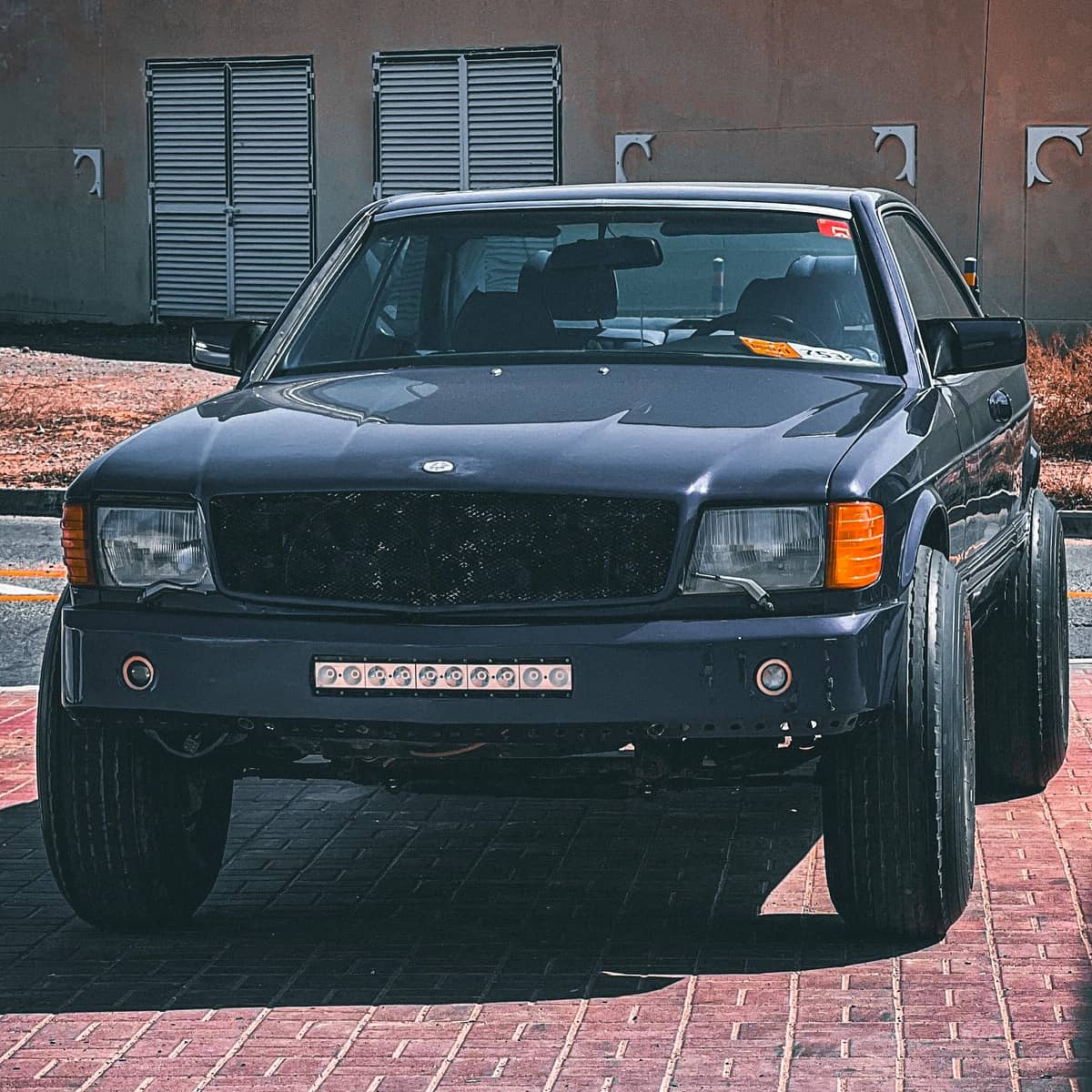
When you think about off-roading in UAE, solid-axle 4x4s with locked diffs and low range like Nissan Patrol or a Land Cruiser are the ones that come to mind in the first place, but what happens when locals get bored with conventional platforms?
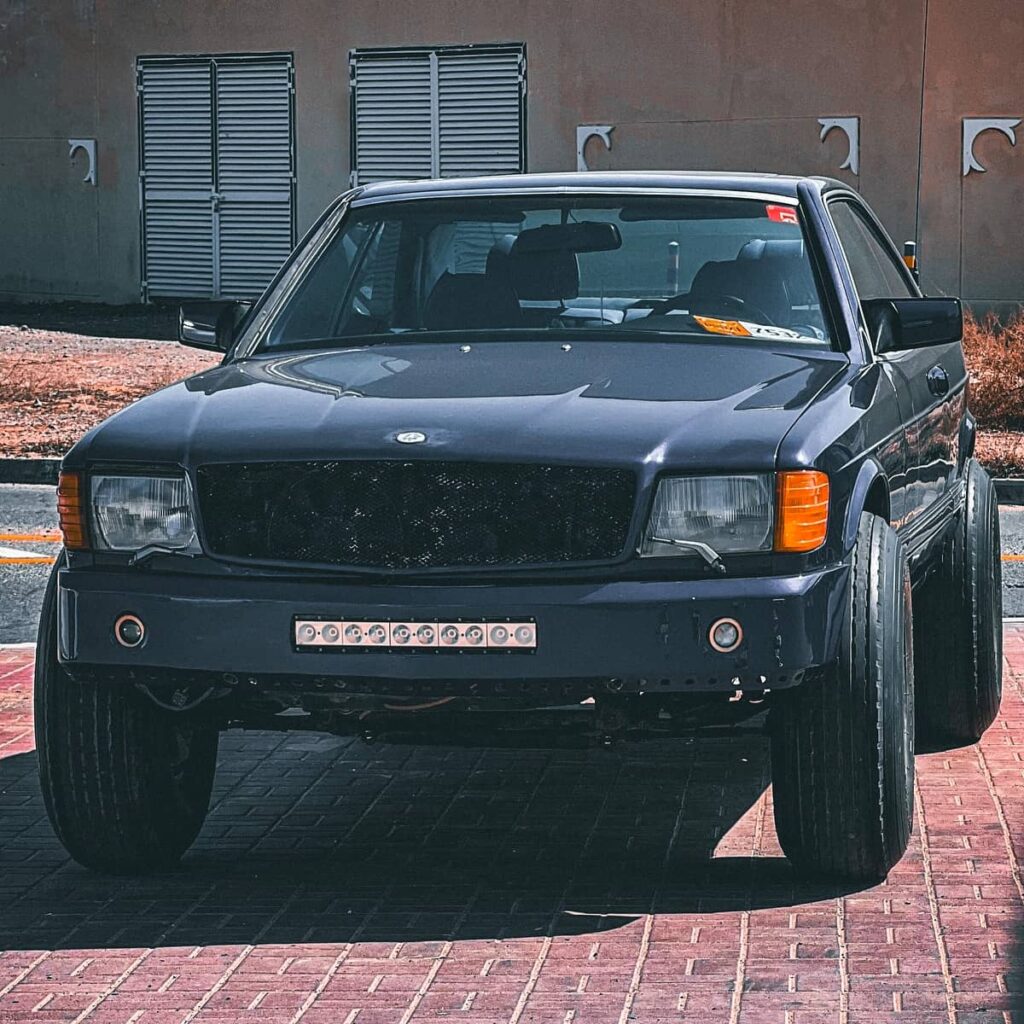
They do some incredibly off-the-wall builds that combine the off-road bits with a taste of luxury. This lifted Mercedes 560SEC C126 Coupe is a perfect example of this concept – a flagship luxury coupe from the late 80s built into a desert-racing prerunner with all the attributes of this Southern California-native style.
Long travel suspension, oversized 30″ off-road tires, custom steel bumpers and other elements make it a perfect fit for the Offroadium format. Read on to find out more about the architecture of this luxury Mercedes prerunner!
| Modification | Details |
|---|---|
| Vehicle | Mercedes-Benz 560SEC Coupe (C126 / W126 body) |
| Tires | Maxxis M8070 900 R15 sand tires (“balloon tires” / “900s”) |
| Wheels | 15×7 Method Race Wheels with true beadlock rings |
| Suspension | Fully custom one-off lift with fabricated rear trailing arms |
| Front Bumper | Custom-fabricated high-clearance, color-matched to the body |
| Lighting | Flush-mounted 12″ LED light bar + two round LED pods |
| Grille | Badgeless blacked-out wire mesh (star and chrome deleted) |
| Desert Kit | Tall whip antenna for safety flag and VHF/UHF comms |
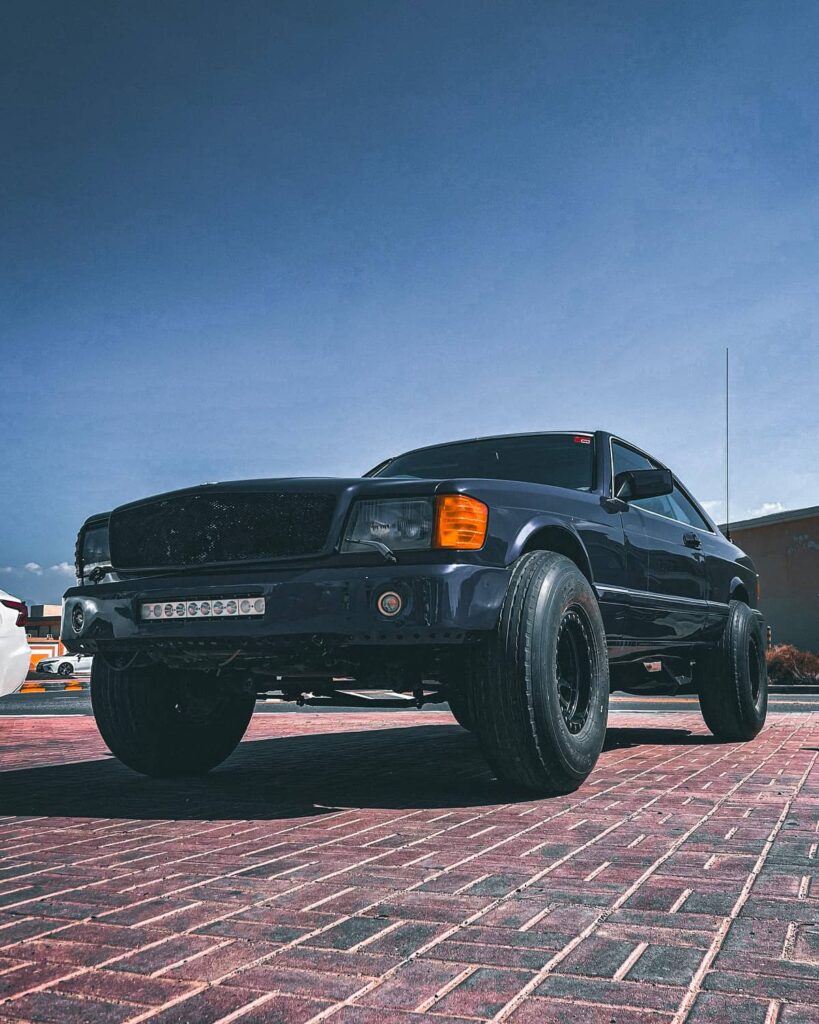
The Build
Even though the S-Class coupe was engineered to cruise the Autobahn at 140 mph, the base of the 560SEC actually doesn’t contradict common prerunner building principles. It’s a long and heavy rear-wheel-drive platform with a powerful V8 motor. The only difference from common Ranger or Silverado prerunners is that it’s unibody – which puts some limitations on the suspension modification scenarios.
This C126 Safari build brings me the memories of a classic movie called “The Cannonball Run.” and the safari-style Rolls-Royce Silver Shadow driven by Jamie Farr’s character, Sheik Abdul ben Falafel.
The absence of common 4WD tech such as low range and lockers doesn’t matter much for high-speed driving in the dunes (a common activity for Gulf off-roading). It usually requires flotation (a wide, soft footprint so you don’t dig in), momentum (power on tap to keep the car moving), and clearance (so you don’t belly-out on a bump). A big-torque V8 sending power to the rear wheels through massively wide, low-pressure float tires is actually a proven desert racing formula.
Wheels & Tires
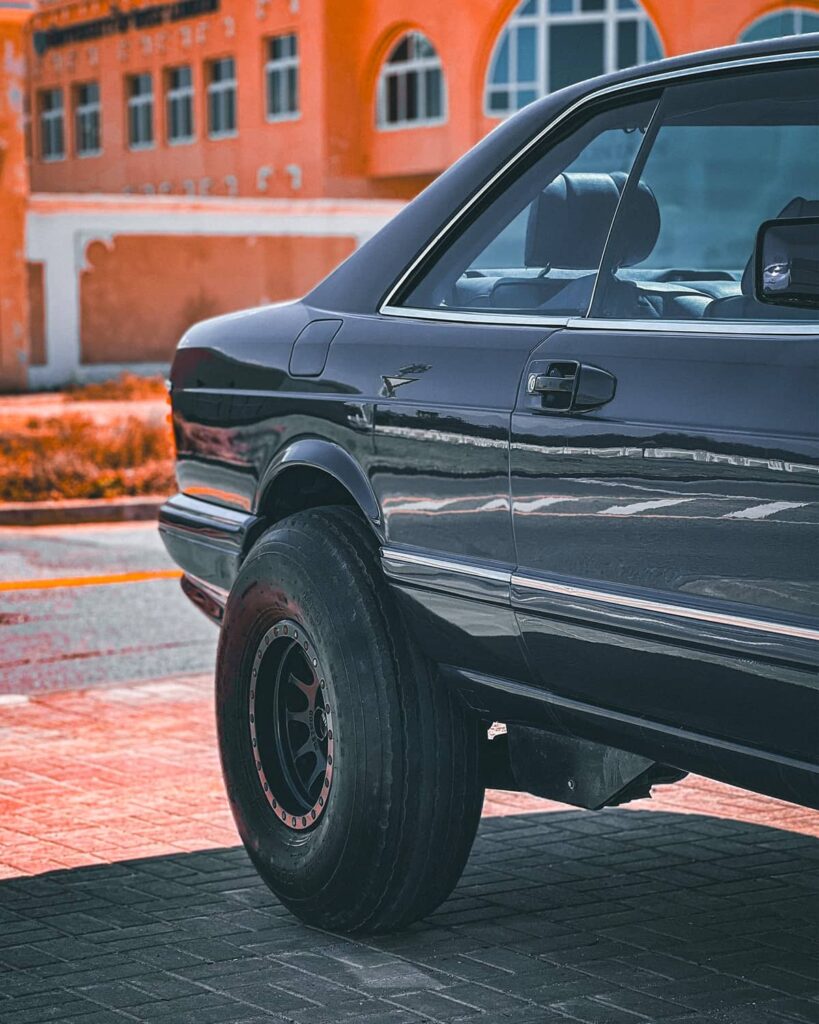
Wheels are definitely the heart of the entire build, and it’s the part most Western builders would get completely wrong. Those aren’t mud terrains and they aren’t paddle tires, they’re Maxxis M8070s in 900 R15, a dedicated bias-ply sand tire that Gulf desert guys universally call “balloon tires” or just “900s” after the common 900-15 and 900-16 sizing. They’re tall (comfortably over 30 inches), round-shouldered, run a nearly smooth ribbed tread, and their sidewalls are deliberately floppy.
That floppiness is actually one of the strongest features of this particular tire. When aired down, the M8070 balloons out into a huge, soft, pillow-like contact patch that spreads the vehicle’s weight over a wide footprint. Instead of cutting down into the dune like a knife and high-centering, the car floats across the top.
An aggressive M/T with stiff sidewalls and big lugs would do the exact opposite, bogging itself down in about four seconds. If you’re building for soft sand, tread pattern matters far less than sidewall compliance and footprint area. As for me, this is the single most misunderstood tire choice in off-roading.
The rims are 15×7 Method Race Wheels with true beadlock rings, and they are here for a reason – they securely hold the above-described balloon tire on the rim when running low pressure (8, 6, or sometimes even 5 PSI).
At those pressures a conventional tire will roll straight off the rim under any lateral load, which on a dune face means an instant rollover.
The trade-off worth flagging is that a bias-ply sand tire is noisy, vague, and too floaty to be used on paved roads – that’s why this isn’t the setup you’d want to daily on the highway.
Budget Estimate
Estimated cost for the rolling stock is roughly $2,800–3,750 — figure $160–190 per Maxxis M8070 and $330–400 per Method beadlock across five corners (spare included), plus $200–500 for adapters or a redrill to the Mercedes bolt pattern and another $150–300 to mount, balance and properly torque the beadlock rings.
Suspension
A heavily oversized 30″ tire like this requires much more space in the wheel wells to be installed, that’s why keeping the suspension stock was never an option. Taking into consideration desert terrain with numerous bumps and whoops, improving the suspension travel was another challenge the builders had to take on.
The stock 560SEC is equipped with a semi-trailing arm independent rear suspension, and that layout is what makes it different from conventional trucks used for prerunner builds. On the Benz, the wheel doesn’t travel in a straight vertical line, it swings through an arc. Lift the body up with a coil spacer and you drag the rear wheels down that arc into a negative camber and toe change.
The fix is the thing you can actually see in the photos – massive custom trailing arms extending beneath the rear wheels. Those custom fabricated arms reposition the suspension pickup points so the geometry is corrected at ride height. The wheel sits back at optimal camber and toe angles, and the arc it swings through is usable again rather than destructive.
Lengthening the arms also physically pushes the wheels down and out, which is what buys the clearance to swallow a 30-inch-plus tire without heavily trimming rear quarter panels. On a show-car project like this, maintaining clean looks mattered a lot, and the builders successfully achieved it with such a radical suspension makeover.
Budget Estimate
Estimated cost for the suspension is about $3,800–9,800+ — roughly $2,000–5,000 for the one-off lift (springs, shocks, mounts and hardware), $1,500–4,000+ for the fabricated rear trailing arms, and $300–800 in subframe reinforcement and geometry-correction hardware. This is the widest-swinging number in the whole build, because you’re buying a fabricator’s time, not a part number. Budget another $800–1,500 in install labor plus $200–400 for a proper geometry setup if you’re not doing it yourself.
Exterior Modifications
The factory front bumper on a C126 is notoriously low, with a long, chin-scraping plastic-and-chrome assembly hanging out ahead of the front wheels, which significantly limits the approach angle.
Rather than doing the lazy thing and simply deleting the bumper (which always looks like an unfinished project car), the builder fabricated a custom high-clearance front bumper with an integrated 12″ central LED light bar, which dramatically improved the approach angle, added more light, and maintained the clean looks.
Budget Estimate
Estimated cost for the body work is around $1,650–4,850 — the custom-fabricated front bumper is the big one at $1,200–3,500+, plus $200–600 to color-match and blend it into a 30-year-old dark blue (matching aged factory paint is the tricky part), $100–300 for the mesh grille insert, and $150–450 for smoked headlight housings.

List of Modifications
Wheels & Tires
- Maxxis M8070 900 R15 desert / sand tires (“balloon tires” or “900s”)
- 15×7 Method Race Wheels with true beadlock rings
Suspension
- Fully custom one-off suspension lift
- Custom fabricated extended rear semi-trailing arms
Exterior & Armor
- Custom-fabricated high-clearance front bumper, color-matched to the body
- Badgeless blacked-out wire mesh grille (chrome grille and hood star deleted)
- Smoked headlight housings (amber corner markers retained)
Lighting
- Flush-mounted 12″ central LED light bar (integrated into the front bumper)
- Two round LED pod lights flanking the main bar
Other Modifications
- Tall rear whip antenna (safety flag mount + VHF/UHF radio comms)
Conclusion
A lifted W126 safari off-road build on 30″ balloon tires sounds pretty insane, and it actually is, considering the amount of labor invested into making this German luxury coupe from the late 80s a real desert-racing prerunner.
Featuring long-travel suspension with custom trailing arms, oversized sand tires, and a custom high-clearance bumper, this Mercedes project is the perfect blueprint for anyone looking to convert a unibody car with independent suspension into something much more off-road-worthy.
All in, the modifications on this build land at roughly $8,250–18,500 in parts and fabrication if you’re doing the labor yourself, with the suspension geometry work being the biggest swing factor in that range. If you choose to commission a shop for the full build, all-in cost easily climbs into the $30,000–50,000 territory.
Find out more about this lifted Mercedes 560SEC desert build by visiting the Instagram profile of the photographer who spotted it in Ras Al-Khaimah: @gandhiculous
Stay tuned for more project reviews on Offroadium.com – Follow us on social media, and share this write-up if you enjoyed reading it!